

Attachment Styles and Sex: How Your Nervous System Shows Up in Bed | Second Banana
How You Were Loved
Is How You Have Sex.
Attachment theory, erotic life, and the nervous system patterns you brought to bed before you knew they had names
The Pattern You Keep Finding Yourself In
There is a particular kind of conversation that happens in therapy offices and between close friends at 1am and in the internal monologue of a lot of people who are otherwise functional and self-aware. It goes something like: I keep ending up in the same situation. The details change. The person changes. The dynamic is always the same.
Sometimes the dynamic is: I want more than they give. I read into small signals. Their distance makes me pursue harder, which makes them pull further away, which makes me pursue harder. I know this is happening. I cannot seem to stop it.
Sometimes it is: I want connection genuinely, and then when it arrives I find a reason to create distance. I am most attracted to people who are slightly out of reach. When someone is reliably warm and available, I lose interest in a way that feels involuntary and produces guilt I can’t quite metabolise.
Sometimes it is neither and both: I want closeness desperately and am also terrified of it. The people I am most attracted to are the ones who are most likely to hurt me, which I can see clearly and cannot seem to factor into my choices.
These are not personality defects. They are attachment styles — patterns of relating to intimacy and potential loss that were shaped in the earliest relationships of your life, stored in your nervous system as procedural knowledge about how closeness works and what it costs, and reactivated with remarkable consistency in adult romantic and sexual contexts.
This piece is about what attachment theory actually says, stripped of the pop psychology oversimplification it has accumulated. About how each style shows up not just in relationships but in the erotic life specifically — in desire, initiation, presence during sex, and the aftermath of intimacy. And about what knowing this can actually change.
The Science: Where Attachment Theory Comes From
Attachment theory was developed by John Bowlby, a British psychiatrist and psychoanalyst, in the 1950s and 60s. Bowlby’s central insight was that human infants are biologically primed to form a specific kind of bond with a primary caregiver — not merely for food and warmth, but for the regulation of fear and the experience of safety. The attachment system is an evolved mechanism for survival: staying close to a protective figure when threatened, using that figure as a secure base from which to explore the world.
Mary Ainsworth, Bowlby’s collaborator, developed the Strange Situation experiment in the 1970s, which observed how infants responded when briefly separated from and reunited with their caregiver. The patterns she observed formed the basis of attachment classification: secure, anxious-ambivalent, and avoidant. A fourth category, disorganised, was added later by Mary Main and Judith Solomon to describe infants whose attachment figure was also the source of fear — an impossible bind that produces a characteristic collapse of the attachment strategy.
Cindy Hazan and Phillip Shaver’s landmark 1987 paper proposed that adult romantic relationships operate on the same attachment system as infant-caregiver bonds. This was initially controversial and is now well-established: the same neural circuitry, the same behavioural patterns, the same regulatory function. The person you are sleeping with is, at a neurological level, activating the same system that your earliest caregivers activated. This is not a metaphor. It is the reason why adult intimacy can feel so disproportionately high-stakes.
The Nervous System Is the Point
Attachment is not primarily about thoughts or beliefs. It is about the autonomic nervous system — about states of activation and regulation that precede conscious thought and that shape behaviour from below, before the reasoning mind has had a chance to intervene.
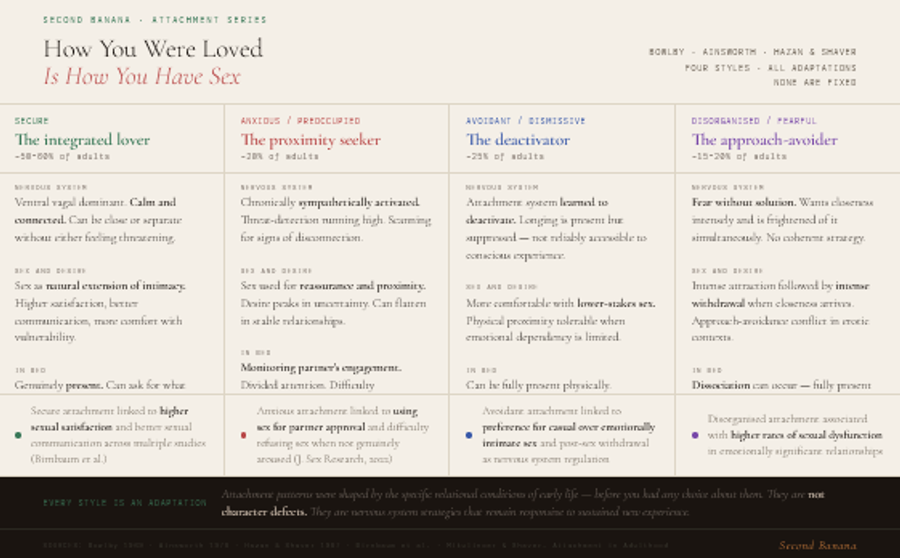
The secure attachment system is associated with ventral vagal dominance: the social engagement system that supports calm alertness, connection, and the ability to be both close to someone and separate from them without the proximity or the distance feeling threatening.
Anxious attachment is associated with a chronically activated sympathetic system: the threat-detection system running at a higher baseline than necessary, scanning relational environments for signs of abandonment, amplifying signals of disconnection, and driving behaviour toward proximity-seeking even when the seeking produces the opposite of what is needed.
Avoidant attachment is associated with a learned deactivation of the attachment system: the nervous system has learned that expressing attachment needs produces rejection or withdrawal from caregivers, and has developed an inhibition strategy that suppresses the signals of need before they can become behaviour. The feelings are present but muted, accessible under conditions of stress but typically unavailable in ordinary relational exchange.
Disorganised attachment involves both activation and no coherent strategy to manage it: the approach-avoidance conflict of wanting proximity from a source of fear, producing a characteristic collapse, dissociation, or freezing that is physiologically distinct from both of the organised strategies.
Secure Attachment: The Baseline Everyone Is Aiming For
Approximately 50–60% of the adult population has predominantly secure attachment, according to the most widely cited research. Secure attachment is not the absence of difficulty or the perfection of relationships. It is a nervous system baseline that allows the full range of relational experience — closeness, conflict, distance, repair — without any of these states feeling existentially threatening.
Secure Attachment and Sex
Securely attached people tend to experience sex as a natural extension of intimacy rather than as either a test of the relationship or an escape from relational anxiety. Research by Birnbaum and colleagues, examining the relationship between attachment and sexual experience across multiple studies, found that secure individuals report higher sexual satisfaction, more frequent and positive sexual communication, greater comfort with vulnerability during sex, and more consistent integration between emotional and physical intimacy.
Secure people can ask for what they want in bed. They can hear no without it becoming evidence of rejection. They can be physically vulnerable without that vulnerability feeling dangerous. They can be present — genuinely inside their own experience rather than monitoring their performance or their partner’s level of engagement — in a way that the other styles make considerably more difficult.
The erotic life of a securely attached person is not necessarily more adventurous or more frequent than that of insecurely attached people. It is more integrated: the person having sex is the same person who has dinner, has arguments, and feels cared for. The sex does not have to carry additional emotional weight because the relationship is doing that work directly.
Anxious Attachment: When Closeness Is Never Quite Close Enough
Anxious attachment develops when early caregiving is inconsistent: available and warm at some times, distracted or withdrawn at others, with the infant unable to predict which version of the caregiver will be present. The adaptive response is to amplify the attachment signal — to become more demanding, more expressive of distress, more vigilant for signs of the caregiver’s attention or inattention — because louder need is more likely to produce a response from an inconsistent caregiver.
In adult relationships, this strategy persists as a nervous system default: hypervigilance to signs of withdrawal or cooling, amplified distress in the face of relational uncertainty, and a pull toward proximity that feels compulsive rather than chosen.
Anxious Attachment and Desire
Anxious attachment has a complex and often paradoxical relationship with sexual desire. Research by Birnbaum found that anxiously attached individuals frequently use sex as a proximity-seeking strategy — as a way of achieving or maintaining closeness with a partner. Sex is less about pleasure and more about reassurance: the physical closeness of sex provides temporary relief from the anxiety of relational uncertainty, which means desire can feel urgent in contexts of insecurity and flat in contexts of genuine security.
This produces a pattern that is confusing both to experience and to explain. The anxiously attached person may feel most sexually activated when a relationship is new and uncertain, when a partner has been slightly distant, or in the aftermath of conflict. The desire is real — it is just being generated partly by the attachment system’s hunger for reassurance rather than purely by erotic interest. And it often diminishes in stable, secure relationships because the stabilising function sex was providing is no longer needed in the same way.
A 2022 study in the Journal of Sex Research found that anxious attachment was significantly associated with using sex for partner approval, with difficulty refusing sex when not genuinely aroused, and with lower sexual self-efficacy — the felt sense of being a capable and desirable sexual agent. The approval-seeking function of sex is particularly relevant: for anxiously attached people, a partner’s sexual interest functions as evidence of the partner’s continued investment in the relationship, making that interest disproportionately important and its absence disproportionately threatening.
Anxious Attachment During Sex
Inside a sexual encounter, anxious attachment often manifests as a divided attention that prevents full presence. Part of the anxiously attached person’s mind is engaged with the erotic experience. Another part is monitoring: is my partner enjoying this? Are they as engaged as they were last time? Do they seem present? Is something wrong? The monitoring is automatic, not chosen, and it consumes cognitive and somatic resources that would otherwise be available for pleasure.
This is one of the mechanisms behind the finding that anxious attachment is associated with higher rates of sexual dissatisfaction despite relatively high sexual frequency: the sex is happening, sometimes urgently and frequently, but the presence required for genuine pleasure is being diverted into relational surveillance.
Anxiously attached people often also have difficulty communicating sexual needs and preferences, for reasons that connect to the broader attachment dynamic. Expressing a preference risks disappointment. Asking for something risks refusal. Both of these feel not merely uncomfortable but like genuinely threatening relational events, which suppresses the communication that would otherwise enable more satisfying sex.
The Anxious-Avoidant Trap
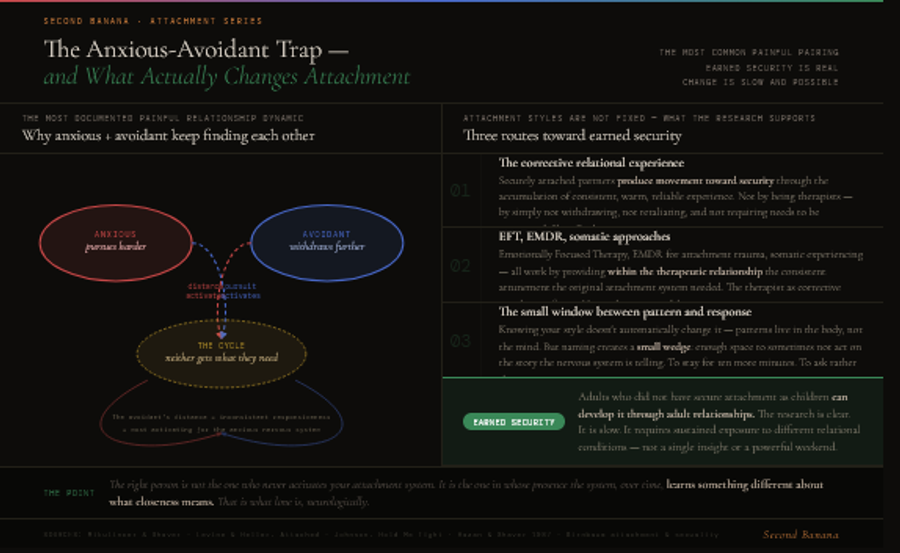
The most frequently documented painful relationship dynamic in attachment research is the anxious-avoidant pairing: an anxiously attached person and an avoidantly attached person in the same relationship, each activating the other’s worst patterns. The anxious partner’s pursuit activates the avoidant partner’s need for distance. The avoidant partner’s distance activates the anxious partner’s need for pursuit. Both are doing the only things their nervous systems know how to do. Both feel perpetually misunderstood. Both are often intensely attracted to each other in a way that is not coincidental: the avoidant’s emotional unavailability creates exactly the inconsistent responsiveness that is most activating for the anxious nervous system, and the anxious partner’s intensity creates exactly the claustrophobic closeness that most strongly activates the avoidant’s withdrawal.
In the sexual dimension, this dynamic often produces a version of responsive desire gone wrong: the anxious partner’s desire is most activated when the avoidant is emotionally distant, which is precisely when the avoidant is least likely to want sex. The moments of genuine connection that the anxious partner craves are also the moments most likely to trigger the avoidant’s withdrawal. The relationship can become organised around the chase rather than the connection — and when the chase occasionally resolves into contact, the sex can be genuinely intense, which reinforces the pattern.
Avoidant Attachment: When Closeness Has a Cost
Avoidant attachment develops when caregivers are consistently emotionally unavailable or actively rejecting of the infant’s attachment needs — when expressing need reliably produces withdrawal rather than comfort. The adaptive response is to inhibit the expression of attachment needs: to become self-sufficient, to suppress the signals of distress, to present as not needing connection while internally experiencing the longing for it.
Adults with avoidant attachment often present as highly functional, independent, and emotionally contained. They may genuinely believe they don’t need closeness in the way others do. Research by Mario Mikulincer and Phil Shaver has shown that the underlying attachment longing is present in avoidantly attached adults — detectable in physiological measures and in implicit association tests — but inaccessible to conscious report. The inhibition is thorough enough that the person cannot reliably access their own attachment needs, which makes it very difficult to express or work with them.
Avoidant Attachment and Intimacy
Avoidant attachment produces what researchers call intimacy avoidance: a discomfort with the emotional closeness that sustained physical and sexual intimacy requires. This is not a discomfort with sex itself — avoidantly attached people can be sexually active, even highly so — but a specific discomfort with the emotional vulnerability that sex makes available.
Research has found that avoidantly attached individuals are more likely to prefer casual sex over emotionally intimate sex, more likely to experience sexual encounters as more satisfying when emotional connection is kept limited, and more likely to use sex as a way of avoiding rather than deepening emotional intimacy. The physical proximity of sex can be tolerable precisely because it provides a scripted context with clear endpoints — unlike the unbounded, unstructured emotional exposure of genuine intimacy.
This does not mean avoidant people do not experience genuine desire or genuine pleasure. It means the conditions under which they are most comfortable sexually are different: lower emotional stakes, greater control over the encounter, and less dependency of the interaction on the quality of the emotional connection between the people involved.
Avoidant Attachment After Sex
The post-sex period is where avoidant attachment is often most visible and most costly to partners. The vulnerability window that opens after sex — which we described in the aftercare piece as a genuine neurological state of lowered defences and heightened need — is exactly the condition that triggers the avoidant’s withdrawal response. The closeness of the post-sex moment is precisely what the avoidant’s nervous system has learned to move away from.
The partner who rolls away immediately after sex, who becomes suddenly logistical or emotionally distant in the moments following intimacy, who seems most comfortable once they have re-established some physical or emotional space — this is often avoidant attachment doing what it does. The behaviour is not indifference to the partner. It is the nervous system regulating an exposure to closeness that it has learned to experience as threatening.
For anxiously attached partners, this post-sex withdrawal is one of the most painful features of the relationship. It arrives at precisely the moment of greatest vulnerability, reads as the most direct possible evidence of the partner’s emotional unavailability, and confirms the fears that the anxious system has been monitoring for throughout the encounter.
Dismissive vs Fearful Avoidance
There are two distinct varieties of avoidant attachment that are worth distinguishing because they look similar from the outside and are quite different internally.
Dismissive avoidant attachment involves a genuine devaluing of closeness: the person has internalised a model of themselves as self-sufficient and of others as generally unnecessary for wellbeing. The longing for closeness is suppressed and not consciously accessible. Dismissive avoidants often genuinely believe they prefer independence and are not aware of experiencing much attachment distress.
Fearful avoidant attachment — also called disorganised attachment in some frameworks — involves a simultaneous strong desire for closeness and intense fear of it. The person wants intimacy acutely and is also genuinely frightened of it, typically because early attachment figures were also sources of threat or harm. This produces a characteristic ambivalence: approaching relationships with intensity, then withdrawing when closeness arrives, cycling between the two in ways that are exhausting and confusing both to themselves and to partners.
Fearful avoidant people often have the most turbulent romantic and sexual lives: the pull toward intensity is real, the fear that proximity triggers is also real, and the behaviour that results from the collision of these two forces is frequently neither what they want nor what they can easily explain.
Disorganised Attachment: The Collapse of Strategy
Disorganised attachment — also called fearful-avoidant in the adult literature — is the least common of the four styles (estimated at around 15–20% of the population) and the most strongly associated with early trauma and neglect. It develops when the attachment figure is simultaneously the source of safety and the source of fear: the parent who is the child’s only refuge is also the one who is frightening or dangerous. This impossible bind produces what Main and Solomon called fear without solution: the attachment system is activated but there is no coherent strategy available to manage it.
In adults, disorganised attachment often manifests as the fearful-avoidant pattern described above: intense attraction to intimacy combined with intense fear of it, difficulty regulating strong emotions in relational contexts, a history of relationships that start with great intensity and become chaotic or abruptly ended, and a particular vulnerability to re-experiencing elements of early relational trauma in adult sexual and romantic contexts.
Disorganised Attachment and Sex
The erotic life of someone with disorganised attachment tends to be characterised by intensity, ambivalence, and a particular kind of dissociation that can make the experience of sex feel split: fully present and then suddenly gone, deeply aroused and then inexplicably flat, connected and then suddenly distant in a way that is confusing to both the person and their partner.
Disorganised attachment is significantly associated with sexual compulsivity and with what researchers call approach-avoidance conflict in sexual contexts: pursuing sexual intensity while also finding that the closeness sex creates triggers defensive responses. It is also associated with higher rates of sexual dysfunction, including difficulty with arousal and orgasm, particularly in the context of emotionally significant relationships.
People with disorganised attachment are also at higher risk of finding that early trauma surfaces in sexual contexts even when the current encounter is consensual and wanted: the body has its own memory, and physical vulnerability can activate stored material in ways that are not predictable and not under conscious control. This is one of the reasons why somatic approaches to healing — the kind we described in the tantra and shame pieces — have particular relevance for disorganised attachment: the healing needs to happen where the pattern is stored.
Can Attachment Style Change? The Evidence
The most important and most frequently misunderstood aspect of attachment theory is that attachment styles are not fixed personality traits. They are learned strategies that remain responsive to experience. The same neural plasticity that allowed the original attachment patterns to be encoded allows them to be modified — slowly, through sustained experience that contradicts the existing model.
The research on what changes attachment is consistent: relationships with securely attached partners over sufficient time, therapeutic relationships that provide consistent attunement and repair, and any sustained experience that provides the corrective emotional experience of need being met reliably rather than inconsistently or not at all.
This is not a rapid process. The original attachment patterns were encoded in a developmental period characterised by high neural plasticity and were reinforced over years. Changing them requires sustained exposure to different relational conditions, not a single insight or a powerful weekend workshop. But they do change. The research on earned security — the development of secure attachment in adults who did not have it as children, through adult relationships — is clear on this.
What Therapy Can Do
Attachment-informed therapy — including but not limited to Emotionally Focused Therapy (EFT), EMDR for attachment trauma, somatic approaches, and some forms of psychodynamic therapy — works by providing within the therapeutic relationship the kind of consistent, attuned, repair-oriented experience that the original attachment system needed and didn’t receive. The therapist functions, in this sense, as a corrective attachment figure: not a replacement for adult relationships, but a laboratory for practising the experience of need being met.
For sexual and romantic difficulties specifically, therapists who work at the intersection of attachment and sexuality — using approaches that address both the relational and erotic dimensions — are often more effective than either pure sex therapy (which may address behaviour without the underlying relational pattern) or pure attachment-focused therapy (which may address the relational pattern without the erotic dimension).
What Partners Can Do
If you are the securely attached partner in a relationship with someone with insecure attachment, you are in one of the most effective positions for facilitating change that exists. Research has consistently found that secure partners produce movement toward security in insecurely attached partners over time, through the simple accumulation of consistent, warm, reliable relational experience.
This is not a prescription to become a therapist to your partner, or to absorb relational patterns that are causing you harm. It is an acknowledgement that the experience of being reliably received by a partner who doesn’t withdraw, doesn’t retaliate, and doesn’t require you to suppress your needs is, for an insecurely attached person, a genuinely therapeutic experience — one that slowly updates the nervous system’s model of what closeness means and what it costs.
Attachment and the Erotic Life: What Changes When You Know
Knowing your attachment style does not automatically change your attachment patterns. The patterns live in the body, not in the mind, and intellectual understanding does not reach them directly. But naming creates the possibility of something that is very difficult without naming: the metacognitive space between the pattern and the response to it.
The anxiously attached person who can recognise, in the moment of scanning their partner’s face for signs of withdrawal, this is my attachment system, this is the monitoring, this is not reliable information about what is actually happening — has not eliminated the monitoring. But they have a small window in which to choose not to act on it. To stay with the sensation rather than the story. To ask, rather than assume.
The avoidantly attached person who can recognise, in the moment of feeling the pull to create distance after sex, this is the deactivation, this is the withdrawal, my partner needs something right now that my nervous system is trying to avoid giving — has not dissolved the avoidance. But they have a small window. Staying for ten minutes. Saying something brief. Not disappearing into the phone.
The disorganised person who can recognise that the sudden dissociation during sex, the inexplicable flatness, the urge to exit a moment of genuine closeness, is a nervous system response rather than evidence that the connection isn’t real — has not healed the wound. But they have a small window to stay rather than flee.
You didn’t choose your attachment style. It was chosen for you, by people and circumstances that preceded your capacity for choice. What you can choose, slowly, is what to do with the small windows that naming it opens.
Second Banana and the Question of Attachment Fit
Second Banana’s post-first model is, in attachment terms, a legibility tool. When someone writes about who they are and what they need before any individual has had the opportunity to trigger their attachment system, they are giving the most honest account of themselves that the anxious monitoring, the avoidant inhibition, and the disorganised ambivalence have not yet obscured.
The Second Banana tag system allows attachment-relevant communication before the first charged interaction. Tags like “secure base,” “need consistent communication,” “emotional availability essential,” “no pressure for immediate closeness,” “gradual depth preferred” — these are not just preference statements. They are attachment disclosures. They communicate something about what kind of relational environment the person needs in order to bring their actual self to an encounter rather than their defensive self.
The anonymous posting model matters here in a specific way. Attachment systems are activated by exposure to specific people — by eye contact, by voice, by the particular quality of someone’s attention. Reading someone’s written account of themselves, before any of those activation cues are present, allows for a kind of assessment that the attachment-primed state of early in-person contact makes almost impossible. You can read from a regulated state what you might otherwise be reading from an already-activated one.
And the community. The Second Banana community skews toward people who have done some version of this work — who have thought about their patterns, who communicate with specificity, who understand that what they bring to intimacy is not a fixed set of characteristics but a nervous system shaped by history. These are the people most likely to be able to offer something that insecurely attached people most need: consistency, repair after rupture, and the patient accumulation of experience that eventually updates what the nervous system believes about what closeness means.
The Relationship Your Nervous System Is Looking For
Every attachment style is an adaptation. Anxious attachment is what a nervous system learns when inconsistent caregiving is what’s available — and amplifying the signal is the rational response to an unpredictable environment. Avoidant attachment is what a nervous system learns when expressing need reliably produces rejection — and suppressing the signal is the rational response to a caregiver who cannot tolerate it. Disorganised attachment is what a nervous system learns when there is no safe response available — and collapsing the strategy is the only option left.
None of these are failures of character. None of them make you unsuitable for love or incapable of a satisfying erotic life. They are the strategies your nervous system developed to navigate the specific relational conditions you encountered before you had any say in the matter.
What they do is make some kinds of connection harder and some kinds of partner better for you than others. The anxiously attached person does not need a partner who will never trigger the monitoring — no such partner exists. They need someone whose consistency, over time, gives the monitoring system less evidence to work with. The avoidantly attached person does not need a partner who will never make intimacy feel costly — it will always feel somewhat costly. They need someone whose patience with the withdrawal and whose continued presence after it slowly teaches the nervous system that closeness does not require flight.